


Photography & Found Objects

Materials Explored:
Digital photography with iPhone and iPhone editing settings
Using found objects, especially as a subject for photography

Process:
As a class we all chose a few personal objects we had on us or in our backpacks and assembled them a certain way in front of us. Then we went around the room and compared what we could learn about each other with what objects were chosen and how they express ourselves. This is what we used for "found objects" or objet trouve" as our textbook (Exploring Studio Materials, Teaching Creative Art Making to Children by Mary Hafeli) calls it on page 199. With more time and for a class it would be great to get found objects to transform into art by collecting things from around the house (like bottle caps), finding discarded material in nature or around town (see the @stooprva instagram if in Richmond) or from up cycle places (like Upcycle Creative Reuse Center in the DMV area or Scrap RVA in Richmond).
With my personal semester theme being "texture" I went on a walk and tried to capture close ups of as many textures as possible

Findings:
Found Objects:
Sometimes the best way to incorporate found objects into artwork, especially if they are purposefully meaningful and used as a self portrait, is to document their arrangement with an artsy photo as a way to not damage or lose the objects and to keep them in case it's needed regularly (like a set of keys). Another solution would be to trace found objects and create artwork with repetitive overlapping lines so found objects can be incorporated into artwork without being damaged by being transformed irreparably or glued down to a surface
Photography:
Having to find textures in my everyday surroundings that I usually overlook was a great way to practice observation skills. Maybe exploring and collecting textures through photography could be a lesson that could be built off of with a lesson where kids could use those textures as a reference and experiment with trying to draw them with charcoal and graphite
It was also a great way to explore the space. When I taught filmmaking at a camp I noticed on the first day kids were usually distractable and not used to the space and would be looking around, so I would use a "group tour of the building" as one of many active activities to get them up and moving around to place between activities where I needed them to sit down and pay attention. I felt like they paid better attention to my presentations if I could "run them" in some way beforehand so a photography scavenger hunt would be a great activity to do to tire them out before giving kids a presentation
If I could use a camera like a Cannon I could teach controlling ISO, aperture and shutter speed

Ideas for Application in the Classroom:
A scavenger hunt to find as many textures as possible
A scavenger hunt to find as many different shot types they can get with a teammate as possible

This lesson could build on the collage lesson about identifying how different shot types help convey different emotions
Differentiation Strategies:
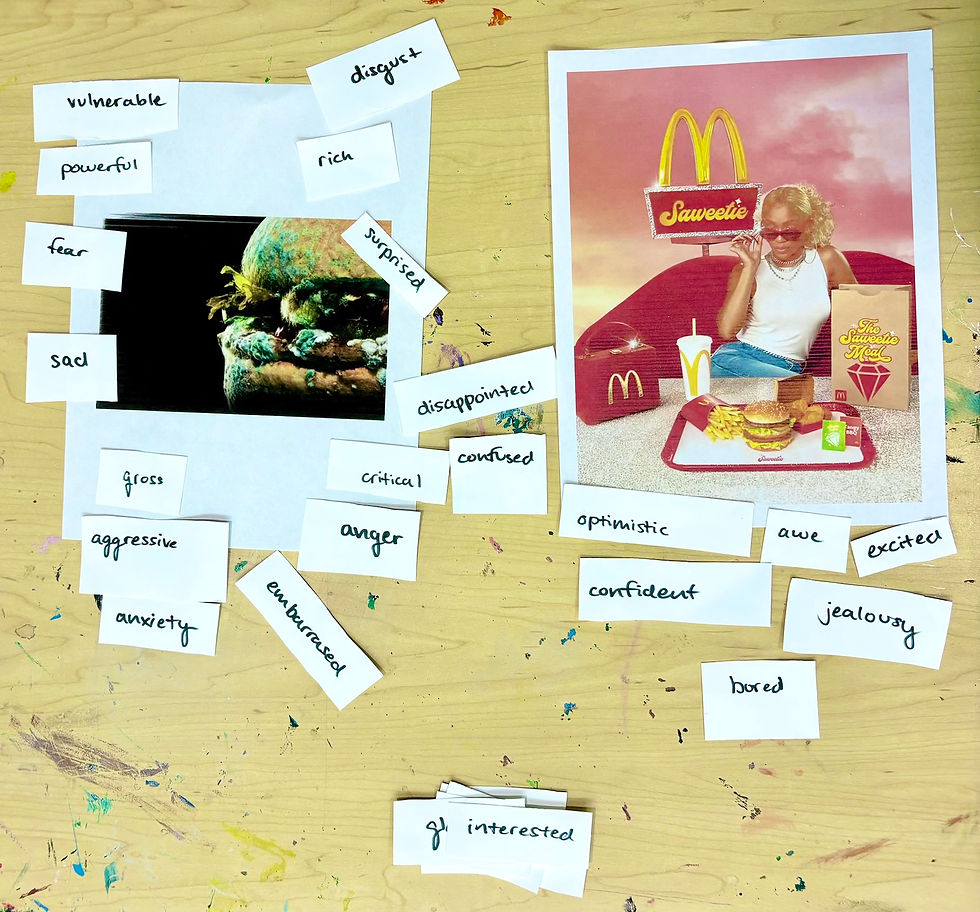
Could ask students to pair photographs and pair it with cut out pieces of paper with emotions and adjectives and challenge them to explain their choices based on the:
Camera angle
Composition
Color
Texture
This can build their vocabulary and help them identify what strategic choices give an image emotional impact. This will help kids build skills for higher level art critiques for when they reach the older grades. During the discussion, ban the word “I like” and “I don’t like” to force them to use art terms and notice and then describe how those concepts are being used
As a teacher, its best to grade on the strategic use of these elements and critical thinking skills behind a piece. This allows varying outcomes in the kids finished products while still mastering the same concepts and fulfilling the assignment. This rewards diversity of thought in how the kids may approach a lesson prompt differently. Teaching kids how to critique productively with constructive feedback can help kids understand how their art making choices get perceived by other people, which can train them as they practice their communication skills

Other Differentiation Strategies:
Pairing students into teams based on their different abilities (a tech savvy student with a very imaginative student or a confident editor with a kid without prior experience)
Offering types of tripods or phone stabilizers for students with motor difficulty


Comments