


Differential Learning
Restaurant Lesson Plan
Group Project Planned By Sadie Carfagno, Noelle Cooper, Kayley Newlon

In our textbook Exploring Studio Materials, Teaching Creative Art Making to Children by Mary Hafeli, we learned many different strategies for building a lesson plan and incorporating differentiated learning. One suggestion was to create a "learning menu" of activities. This is where you plan a series of activities that build on each other in 3 parts or "courses" and students get to choose which activities they want to participate in for each course
When doing a site visit to Oak View Elementary, one of the teachers said "students are more likely to behave if they feel like they are given a choice" which this type of lesson plan plays nicely into
This creates differentiated learning because the many options of tasks to choose from can meet the diverse needs, interests, abilities, and learning styles of a classroom. This is because even within one classroom there will be a wide range of these abilities and every kid with work at a different speed or have different motor skill abilities. While there's one theme, students can chose to explore it at different levels of complexity. That way more advanced students don't have to hold back their abilities when following directions and less advanced students who may take longer can choose something less daunting they can accomplish in within class time
After substitute teaching 8-11 year olds for 2 days (with other lesson plans), I learned a lot from that experience and there are a few ways I would revise this lesson plan (see bottom of page). My most important take away was realizing how dramatically wide the range is when it comes to how long it takes for students to complete a task. Kids who finished early needed something to do and became disruptive to kids still working. I could plan additional, optional tasks that could be added onto each project for the speedy kids that the less-speedy kids wouldn't feel pressured to do

Restaurant Lesson Plan
Ages 8-11
Orbital Studies: Theme around food and how it relates to emotion
Choose One Appetizer: (3 min)
In your seats brainstorm in your sketchbook your different emotions and/or memories around food. Think of positive or negative experiences you’ve had. Think about how different emotions can be associated with different shapes and colors:

A great example of how to create a mind map to brainstorm emotions and connect ideas by another group in class At a station set up in one area of the classroom, look at [a couple of teacher pre-selected] advertisements for food from magazines.
How is the food portrayed in the ad; what colors are they using; who or what surrounds the food; how does the ad make you feel? Sort the printed out emotion words and categorize them under each ad:
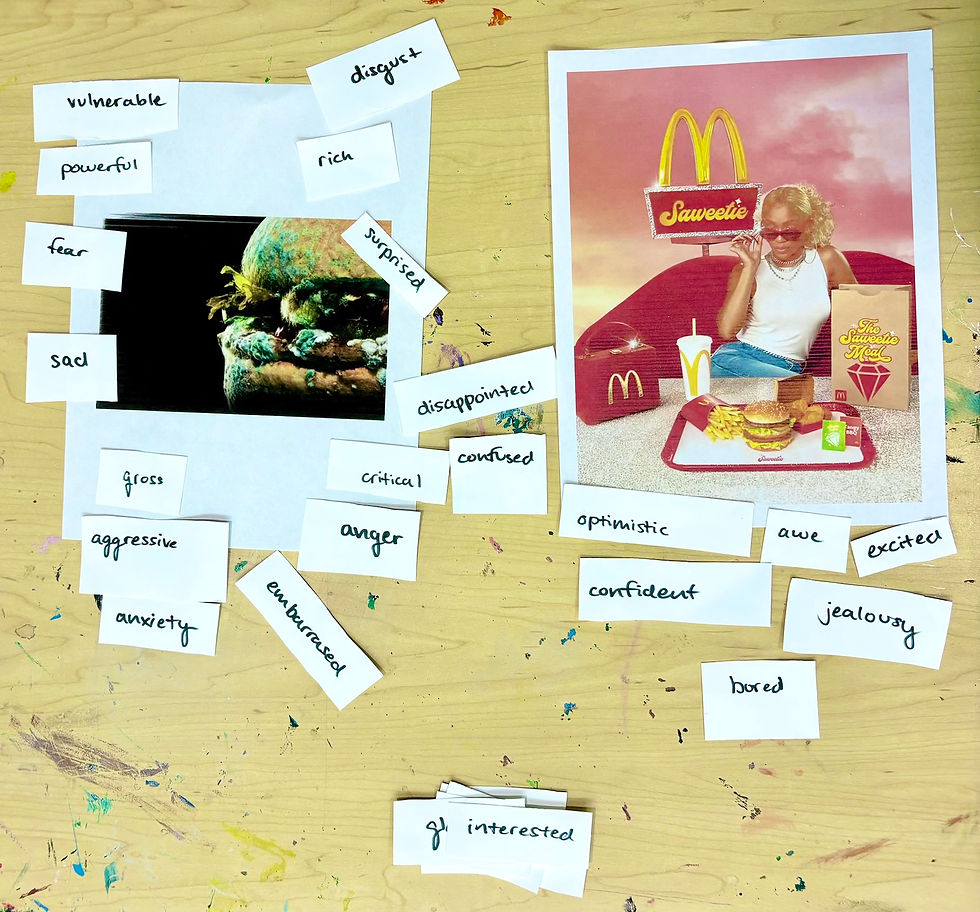
Have A Main Course (but you're allowed to play with your food!):
Brainstorm your favorite foods and think of how you could recreate them with paper materials. Sort potential materials that you would be interested in using such as magazines, construction paper, newspaper, and tissue paper. Organize your materials based on color or texture. If interested, experiment with the paper by twisting, ripping, cutting, or crumpling. See what the effects of these are on the paper and think about what foods could be best represented by them
Choose One Dessert:
Create an abstract collage around a particular emotion or feeling associated with food. You can think of a specific memory that could be negative, positive or neutral. How would you visualize that feeling or sensation you experienced? Things to focus on are color, and texture

Use the print out of a plate and create a collage of a meal on top of it. Students are welcome to make their own plate out of collage materials/paper. It could be a meal you’ve had in the past, or an imagined meal with foods that don’t exist in reality like rainbow honey

Imagine a dinner party scene and create a collage of the party. Think of what food is on the table, who is around the table, or are there decorations? It could be a realistic scene like a Thanksgiving dinner or a fantastical scene with monsters or animals present. You can use the print out of the dinner table to build on top of or make your own collage from scratch

Revision:
Restaurant Lesson Plan
Ages 8-11
Orbital Studies: Theme around food and how it relates to emotion and building vocabulary with adjectives
Choose One Appetizer: (3 min)
At a station set up in one area of the classroom, look at [a couple of teacher pre-selected] advertisements for food from magazines.
How is the food portrayed in the ad; what colors are they using; who or what surrounds the food; how does the ad make you feel? Sort the printed out emotion words and categorize them under each ad:
Brainstorm your favorite foods and think of how you could recreate them with paper materials
Sort potential materials that you would be interested in using such as magazines, construction paper, newspaper, and tissue paper. Organize your materials based on color or texture
If interested, experiment with the paper by twisting, ripping, cutting, or crumpling. See what the effects of these are on the paper and think about what foods could be best represented by them
Can you assign paper slips of adjectives or emotions to your sorted piles like "disgust, happy, tasty, gross, slimy, crunchy, dry, sweet, fruity, bitter, warm...etc"
Have A Main Course
Create an abstract collage around a particular emotion or feeling associated with food. You can think of a specific memory that could be negative, positive or neutral. How would you visualize that feeling or sensation you experienced? Things to focus on are color, and texture
Use the print out of a plate and create a collage of a meal on top of it. Students are welcome to make their own plate out of collage materials/paper. It could be a meal you’ve had in the past, or an imagined meal with foods that don’t exist in reality like rainbow honey
Optional: Choose desserts if you finish early
Add to your work:
More toppings
Utensils
Decorate the tablecloth around the plate with marker
A side dish on the plate or on another plate
Crumbs
Is a mouse or ant or picture of something from the magazines going to eat the crumbs?
Imagine a dinner party scene and create a collage of the party. Think of what food is on the table, who is around the table, or are there decorations? It could be a realistic scene like a Thanksgiving dinner or a fantastical scene with monsters or animals present. Images you find in the magazines may inspire you. You can use the print out of the dinner table to build on top of or make your own collage from scratch


Comments